The partnership runs on a handshake: why agreements protect relationships
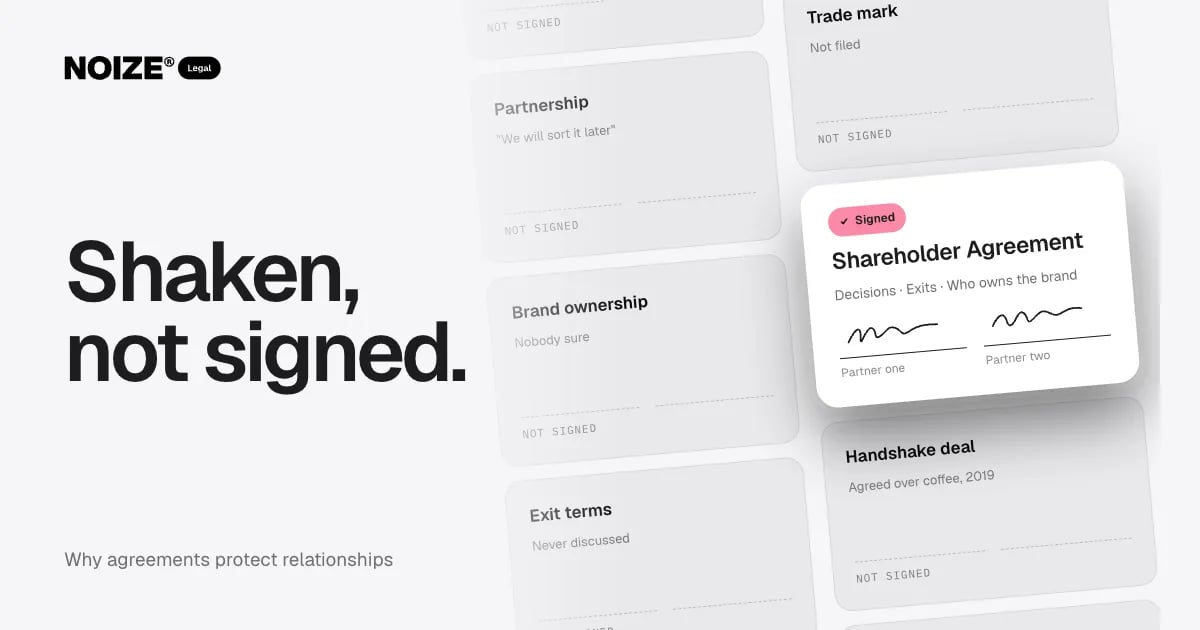
Two friends start a business. They agree over coffee to split it evenly, work hard and sort out the details later. For years, it works. Then one wants to slow down, another wants to bring in an investor, or a disagreement over direction won't resolve. And the details they planned to sort out later have never been written down.
The partnership runs on a handshake. It is one of the most common situations we see, and it is far easier to fix while everyone still agrees.
The short version
- A shareholder or partnership agreement settles the questions owners hope never to face: who decides what, how profits are shared, what happens if someone wants out, how the business is valued, who owns the brand and how disputes are resolved.
- Writing it down early, while everyone gets along, protects the business, the relationship and each owner's investment.
- NOIZE provides administrative support and business strategy.
- Where work is outside our skillset, or the law requires it, we make sure an appropriately qualified professional is involved.
Why handshake deals fail
01Memories differ
Years later, partners remember the original agreement differently, honestly.
02Circumstances change
Health, family, ambition and finances shift. An arrangement that suited both at the start may not suit either later.
03Contributions become uneven
One partner works more hours or invests more money. Without an agreement, resentment builds.
04Exits are unplanned
When someone wants to leave, there is no agreed way to value their share or fund the buyout.
05New people arrive
Investors, key staff or family members want a share, and there is no process for it.
What an agreement settles
01Decision-making
Which decisions need unanimous agreement, which need a majority and which can be made by one owner.
02Roles and contributions
What each owner is expected to contribute in time, money and responsibility.
03Profit and distributions
How and when profits are paid out or reinvested.
04Exit and transfer
What happens if an owner wants to leave, retires, becomes ill or passes away, including first rights to buy their share.
05Valuation
How the business and each share will be valued in those situations.
06Ownership of assets
Who owns the brand, intellectual property and key relationships.
07Restraints and confidentiality
What owners can and can't do if they leave.
08Disputes
How disagreements are resolved before they become legal battles.
> I've co-founded companies and been through exits, and the cleanest exits always had a clear agreement written years earlier. The partners might have disagreed in the moment, but the document had already answered the hard questions. It saved friendships as well as money.
“What I appreciated most was them pushing back when it mattered.”
An illustrative example
Imagine three co-founders of a growing agency with no agreement. One receives an offer to join a larger firm and wants to sell their third. Without an agreed valuation method or buyout terms, negotiations stall for months and the business is distracted. A shareholder agreement written at the start would have set the valuation method, given the remaining founders the first right to buy and set a timeline for payment.
Mistakes to avoid
- Don't wait for a problem to start the conversation.
- Don't use a generic template without tailoring it to how your business actually works.
- Don't forget to review the agreement when ownership, structure or roles change.
Where Legal fits
NOIZE Legal helps owners put shareholder and partnership agreements in place. How the documents are prepared and certified is agreed with you at the strategy or proposal stage, with an appropriately qualified professional involved where the law requires it. When the structure has tax implications, Legal hands to NOIZE Accounting. When a buyout or new investment needs funding, NOIZE Finance can help. See legal.noize.com.au.
How NOIZE Legal works with you
In practice, NOIZE Legal handles the hands-on work directly: searching the trade mark register, lodging trade mark applications and registering business names. Strategy advice on the partnership runs on a handshake comes with it, so nothing is done in isolation.
Where the law requires a qualified practitioner, or it is outside our skillset, we make sure an appropriately qualified professional is involved. The approach depends on the business and is settled in the proposal.
Nothing is handed to another professional without your agreement, and you always know who is working on what.
Questions to discuss with your co-owners
- What happens if one of us wants to leave?
- How would we value the business?
- Who makes which decisions?
- What if one of us stops contributing?
- Who owns the brand and key relationships?
- How would we settle a disagreement?
Talking these through openly, before anything goes wrong, is the most useful step towards an agreement that works.
Where to start this week
Sit down with your co-owners and answer one question each: what should happen if I wanted to leave the business next year? If your answers differ, or nobody is sure, that is the conversation to formalise.
How Legal connects to the rest of NOIZE
Legal protects what the other departments build. NOIZE Creative develops names and brands, and Legal checks and protects them through trade mark searches and applications. NOIZE Sales relies on clear terms of trade. NOIZE Accounting works with Legal on structure and its tax implications. NOIZE Finance works alongside Legal when a deal needs funding and paperwork at the same time. NOIZE IT supports privacy obligations with secure systems. Where the law requires a qualified practitioner, an appropriately qualified professional is involved, and the approach is agreed with you at the strategy or proposal stage.
Related reading
- Is your brand protected? Trademarks for business owners
- The contract is a template from 2014: terms that protect you today
This article is general information only. It is not legal, tax or financial advice, and it does not take your circumstances into account. Speak to a qualified adviser before acting.
NOIZE provides administrative support and business strategy. Where work is outside our skillset, or the law requires it, we make sure an appropriately qualified professional is involved.
Common questions
What is a shareholder agreement?
A contract between company owners setting out decision-making, contributions, distributions, exits, valuation and dispute resolution.
Do I need a shareholder agreement if we are friends?
Yes. It protects the friendship as much as the business by settling hard questions in advance.
What is the difference between a partnership agreement and a shareholder agreement?
Partnership agreements apply to partnerships. Shareholder agreements apply to companies. Both set out how owners work together.
When should we get one?
As early as possible, ideally before any money or significant work is contributed.
Can we add an agreement to an existing business?
Yes. It is never too late, though it is easiest while owners agree.
What happens without an agreement?
Default rules in company law and the constitution apply, which may not match what owners intended.
How often should it be reviewed?
When ownership, roles or the business structure change.
What should I bring to a legal enquiry?
Tell us what you are signing, protecting or buying, and any existing documents.
Is NOIZE Legal a law firm?
NOIZE Legal handles legal administration and gives business strategy advice. Where the law requires a qualified lawyer, or the matter is outside our skillset, an appropriately qualified professional is involved.
Can agreement cover what happens if an owner passes away?
Yes. Agreements commonly address death, illness and incapacity, often alongside insurance arrangements.
Your first strategy conversation is on us.
Have a chatThe brand for business.