Buying or selling a business: the legal steps that protect the deal
For most owners, buying or selling a business is the largest contract they will ever sign. It involves the business itself, its staff, its premises, its customers, its debts and its future. And it often happens on a tight timeline, with emotions running high on both sides.
The legal steps can feel like hurdles between the handshake and the outcome. In reality, they are what make sure the deal closes on the terms that were agreed, and that nobody discovers an expensive surprise afterwards.
The short version
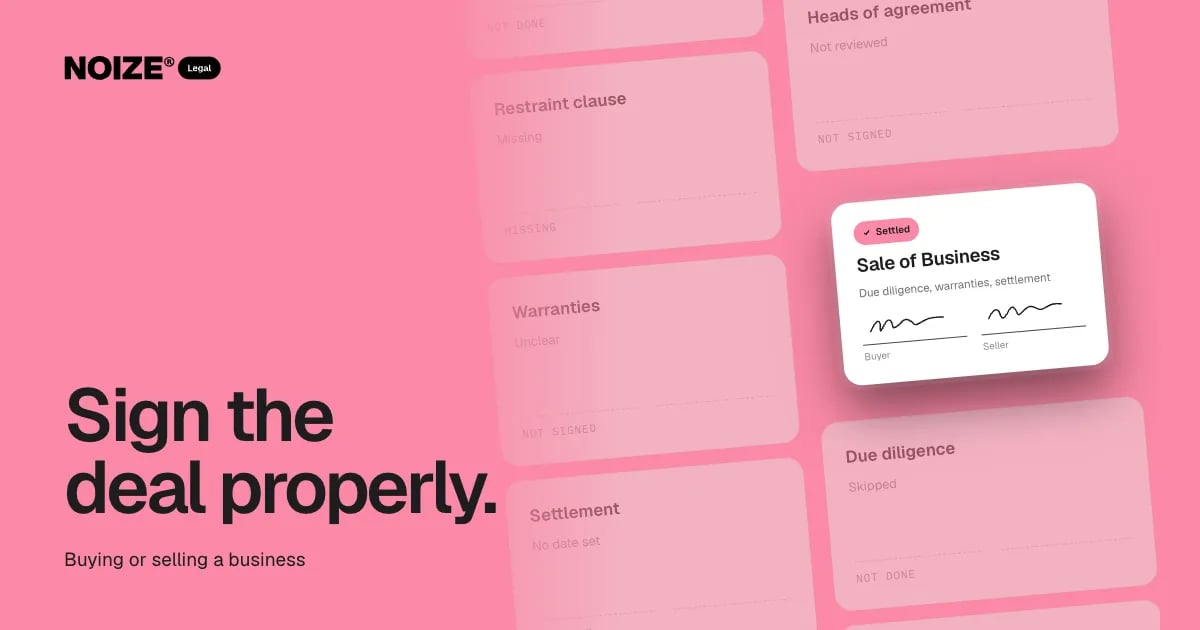
- A business sale moves through heads of agreement, due diligence, the sale contract, funding and settlement.
- Due diligence checks what is really being bought.
- Warranties and restraints protect the buyer.
- Clear terms protect the seller.
- Legal, Finance and Accounting working in parallel get the deal funded, protected and settled on time.
- Preparing early also makes a business easier to sell later.
- NOIZE provides administrative support and business strategy.
- Where work is outside our skillset, or the law requires it, we make sure an appropriately qualified professional is involved.
The stages of a business sale
01Heads of agreement
A summary of the key terms: price, what is included, timing and conditions. Usually not fully binding, but it sets the framework.
02Due diligence
The buyer checks financials, contracts, leases, staff, assets, intellectual property, compliance and any disputes.
03The sale contract
The binding agreement covering price, assets, liabilities, warranties, restraints, staff, conditions and settlement.
04Funding
The buyer arranges finance, often with conditions linked to the contract.
05Settlement
Ownership transfers, money changes hands and the new owner takes over.
Key terms explained
01Warranties
Promises from the seller about the business, such as the accuracy of financial records or the absence of undisclosed disputes.
02Restraint of trade
Limits on the seller competing with the business after the sale, for a defined time and area.
03Assets and liabilities
What is being bought: equipment, stock, intellectual property, customer lists, goodwill, and which debts stay with the seller.
04Staff
How employees transfer, and how their entitlements are handled.
05Leases
Whether the premises lease can be assigned to the buyer and on what terms.
06Conditions
Requirements that must be met before settlement, such as finance approval or landlord consent.
> I've been through successful exits and invested in acquisitions, and the deals that went smoothly had one thing in common: the paperwork was ready before the buyer asked. Clean contracts, a registered trade mark and up-to-date records turned due diligence from a month of stress into a week of confirmation.
“Things really got moving beyond our expectations.”
How Legal, Finance and Accounting work together
At NOIZE, a transaction is run by the departments it touches. Legal coordinates the contract and due diligence, with an appropriately qualified professional where the law requires it. Finance helps prepare the funding side, working with our dedicated broker, with timing aligned to settlement. Accounting advises on structure and tax implications. Running them in parallel avoids the common problem of a contract signed before funding or structure is ready.
Preparing a business for sale
Sellers can make due diligence easier and protect value by preparing early: current financial records, signed agreements with key customers and suppliers, staff contracts, a registered trade mark, a clear lease position and no unresolved disputes. NOIZE Books and Accounting help get the numbers in order.
An illustrative example
Imagine a buyer acquiring a local services business. Due diligence reveals the premises lease expires in eight months with no renewal option, and two major customers have no written contracts. The buyer negotiates a lease extension as a condition of settlement and a price adjustment for customer risk. Finance aligns the loan to the new settlement date. The deal closes on terms that reflect what was actually being bought.
Mistakes to avoid
- Don't skip due diligence to save time.
- Don't sign the contract before funding and structure are confirmed.
- Don't overlook the lease.
What we handle, and when specialists step in
NOIZE Legal does the practical side itself: registering business names, updating ASIC details and keeping company registers in order. Where useful, we add strategy advice on buying or selling a business.
Where a qualified practitioner is required, an appropriately qualified professional steps in. Every arrangement is tailored and agreed at the start.
Some clients want everything handled, others want a second set of eyes. Both work, and the arrangement can change as the business does.
Questions to ask before buying or selling
- What exactly is included in the sale?
- What will due diligence need to cover?
- Can the lease be transferred?
- How will staff and their entitlements be handled?
- What warranties and restraints are reasonable?
- Is funding approved, and do its conditions match the contract?
- Which structure should the purchase use?
Working through these early prevents most late surprises.
Where to start this week
If you might buy or sell in the next few years, list the documents a buyer would ask for: financials, customer contracts, staff contracts, leases and intellectual property. Tick what is current and signed. The gaps show where to start. See legal.noize.com.au.
When a purchase needs borrowing, gather the contract terms, financials and use of funds into one organised funding pack with a cover page. Your broker and lender will thank you for it.
How Legal connects to the rest of NOIZE
Here is how the other departments support this work. NOIZE Finance works alongside Legal when a deal needs funding and paperwork at the same time. NOIZE IT supports privacy obligations with secure systems. Where the law requires a qualified practitioner, an appropriately qualified professional is involved, and the approach is agreed with you at the strategy or proposal stage. NOIZE Creative develops names and brands, and Legal checks and protects them through trade mark searches and applications. NOIZE Sales relies on clear terms of trade. NOIZE Accounting works with Legal on structure and its tax implications.
Related reading
- The partnership runs on a handshake: why agreements protect relationships
- Is your brand protected? Trademarks for business owners
This article is general information only. It is not legal, tax or financial advice, and it does not take your circumstances into account. Speak to a qualified adviser before acting.
NOIZE provides administrative support and business strategy. Where work is outside our skillset, or the law requires it, we make sure an appropriately qualified professional is involved.
Common questions
What is due diligence?
The buyer's investigation of the business before committing, covering financials, contracts, staff, assets and risks.
What is a restraint of trade clause?
A clause limiting the seller from competing with the business for a set period and area after the sale.
Do I need a lawyer to buy a small business?
It is generally worth considering, given the size of the commitment and the protections needed.
How long does a business sale take?
Often several weeks to months, depending on due diligence, funding and conditions.
What happens to staff when a business is sold?
It depends on the deal. Staff may transfer to the buyer, and entitlements need to be handled correctly.
Can the lease be transferred to the buyer?
Usually with landlord consent, depending on the lease terms.
How do I prepare my business for sale?
Get financial records current, formalise key contracts, register your trade mark and resolve any disputes.
Can NOIZE help fund an acquisition?
Yes. NOIZE Finance can arrange acquisition funding alongside Legal.
Is NOIZE Legal a law firm?
NOIZE Legal handles legal administration and gives business strategy advice. Where the law requires a qualified lawyer, or the matter is outside our skillset, an appropriately qualified professional is involved.
Your first strategy conversation is on us.
Have a chatThe brand for business.